 This work is licensed under a Creative Commons Attribution-Noncommercial 4.0 International License


Watermarks; a history of water in Orange and District
Watermarks
This exhibition explores the pivotal role of water in the history, development, industry and culture of the Orange district.
Water sustains land, life and the spirit. It is both abundant and a precious, finite resource. The careful use and management of water and water places is now preoccupying communities, councils and governments. Exploring the water history of the district helps us to recognise the vital place of water in every facet of life in the community, past and present.
Watermarks draws together all kinds of water objects from pipes and plumbing to works of art. It explores water places, stories of people working with water today, and memories of how we worked and played with water in the past. This is not a comprehensive history but a work in progress, where we seek your memories and knowledge of water in all its forms to contribute to our understanding of the subject.
This is a collaborative exhibition developed by Orange City Council, Orange City Library and Orange Regional Gallery in partnership with community museums and history and heritage organisations in Orange, Millthorpe and Canowindra. A special feature of the exhibition is the way many areas of Orange City Council’s operations have worked together to produce a holistic understanding of their diverse work with water.
The exhibition shows the work of local artists and draws on all kinds of water-related objects from community museums and local families. Key themes include natural and environmental history, local water places, civic water supply, gardens, agriculture, domestic water use, mining, sport and recreation. It includes interviews with local people on their work and ideas about water. Orange City Council will continue to work with the community museums on the interpretation of their water-related collections.
The Watermarks project is part of the museum development strategy to raise awareness of significant local collections, change preconceptions about the work of museums and build a diverse range of stakeholders to support museum development in Orange.
Documenting significant objects and collaborating with community museums are important dimensions of the museum program. Watermarks will help develop partnerships with the Orange Regional Gallery and mining, sporting, cultural and environmental groups. It will also develop links with Lucknow and with Council’s new Environmental Learning Facility. When the exhibition closes, materials and graphics will be used in other Council venues and participating museums.
A web site and self-guided driving tour brochure will give this project a long life span for visitors and educational and cultural groups.
This project reflects policies and priorities currently being developed through work on Council’s cultural plan, particularly the way it links heritage places, museums, contemporary culture and tourism. This exhibition has been made possible by the generous support of the NSW Ministry for the Arts and Orange City Council.

Sustaining Life, Land and Spirit

Mt Canobolas and Lake Canobolas
Mount Canobolas, formed through volcanic activity millions of years ago, looms 1395 metres above sea level and is the dominant geographic feature of the Orange district. The height of the mountain produces a strong rainfall effect with water flowing in all directions from the summit. The mountain is a watershed: water falling on the eastern side flows into Towac Creek and from the western side enters Boree Creek.

Mt Canobolas in winter
Cloud often forms around the summit of Mount Canobolas, contributing to high rainfall and supporting a diversity of agricultural activities in the district, such as fruit and vegetables, grapes for winemaking, and grain.
Photo: Orange City Library
The name Canobolas is derived from the Wiradjuri word meaning 'two shoulders'. It was a significant water reserve not only for local Aboriginal people but after white settlement for travelling stock. Snow often dusts the peak in winter. Locals say there is a permanent cloud over the mountain.
Water feeds from Towac Creek into Lake Canobolas, once known as Meadow Creek, Orange's first water supply. The lake is one of Orange's major attractions, popular year-round for excursions and only a few kilometres from the city. There is no better place to enjoy Orange's changing seasonal colours than the lake, with Mount Canobolas looming not far away. There are many orchards in the fertile area surrounding the lake as well as a number of wineries.

Lake Canobolas, a popular recreational area close to Orange, sits just below the mountain. It has long been a favourite place to enjoy swimming, picnics and kayaking.
Photo: William Stewart.

Federal Falls
There are two main waterfalls on Mt Canobolas, Hopetoun Falls and Federal Falls both of which are popular scenic and bushwalking destinations.
Photo: Orange City Library
Rain and Floods
Orange has a relatively high average annual rainfall with winter being the wettest period and summer and autumn the driest. Snowfalls are also experienced between May and September. Snow does not settle on the ground for long, though it does accumulate in sheltered pockets on Mount Canobolas particularly on the southern slopes, for weeks at a time.
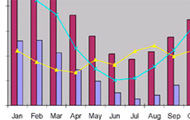
Rain chart
Orange City Council has seven automatic rain gauges located throughout the local government area that not only measure how much rain has fallen but also how quickly it falls. From this information engineers can develop models of creek and channel flows to improve public safety and limit damage to property. Some other physical measures that have been put in place include detention basins that trap floodwaters in large storms. Three rain gauges have been installed near the main water supply dams that report information back to Council and the State Emergency Service. This 'real-time' information is used to ensure the safety of downstream residents in the unlikely event of an extreme flood that could damage the wall of Suma Park Dam.
Blackman's Swamp Creek and its tributary, the East Orange Channel, have been known to break their banks since the earliest days of white settlement. While generally of a short duration and relatively minor these floods do have a significant impact on the community in terms of costs through property damage and inconvenience. The rapid nature of flooding particularly in rural areas can present a particular hazard for the unwary and on some occasions result in loss of life.

A build up of threatening clouds over Mt Canobolas.
Photo: Bill Simpfendorfer

The northern side of Summer Street looking from Lords Place flooded in 1958. Crowds of shoppers would have looked on in awe as floodwaters lapped the gutters.
Photo: Orange City Council
Pluviometer

The Mort Pluviometer was manufactured by Davies Kent (NSW) Pty Ltd. Mort Pluviometers were used extensively in the 1970's to monitor rainfall. This unit was installed at Council's McLachlan Street Works Depot in 1978 and was used to record rainfall for about 20 years before being replaced by a more modern "tipping bucket" style unit, which features electronic recording.
Method of operation
Rainfall is gathered in the funnel at the top of the unit and transferred to the water storage tube. A float in the water storage tube rises as the tube fills and activates the pen drive wheel which moves the pen across the chart drum. The chart drum is powered by a clockwork mechanism with a one-week duration between windings. A graduated chart is attached to the surface of the chart drum. The combination of the rotation of the chart drum and the motion of the pen results in the amount, time and duration of the rainfall event being recorded.
Orange City Council Collection
Tipping Bucket

The most recent units installed by Council are tipping bucket rain gauges. These rain gauges feature electronic recording of rainfall data which can be downloaded onto a computer or viewed in real time via telemetry (networked back to computers at the Council office and depot sites via the internet) with the data available to Council via the internet.
Orange City Council Collection
Rainfall Records, Larras Lake North, from 1927

The Welsh family has been at Larras Lake North since 1927, and they have kept rainfall records ever since.
Loan courtesy Peter Welsh
Many farmers keep rainfall records to understand the precise weather patterns affecting their land. This helps them make decisions about planting and stocking, and sustainable land management. These records are an important resource for understanding the land, and more recently for studying climate change.
Introducing Water in Orange

Senators on Canobolas Orange by E T Luke 1864 - 1938
Orange was one of the three finalists in the search for the best site for Australia's new capital, in the early 1900s. Yass, Canobolas and Eden-Monaro were the finalists. Mr Oliver, the Commissioner of the investigation of the Federal Capital proposed sites, decided against Orange because of the limited supply of water.
Photo: State Library NSW
Orange is isolated from major rivers, relying on perpetual rainfall and an abundant network of creeks. Early explorers followed the main rivers that skirted the district. The original village of Orange was serviced by water reserves along Blackman's Swamp Creek and underground water from many private wells.
The little creek on which the town may be said to be situated, bears the euphonious name of Blackman's Swamp. The only water supply is that of wells but a water scheme is being proposed and sites chosen. From Cassell's Picturesque Australasia 1889.
A windlass and bucket or a pump was used to bring water to the top of the well. Mervyn Henry of Orange said his father George had built wells in Warrendine Street and Franklin Road in the early 20th century and their house in Clinton Street had a Douglas pump with a pipe that reached to the bottom of the well. Wells were not only used as a necessary water supply but were also used as refrigerators by lowering food into them. On occasion the groundwater wells in Orange have dried up leaving the deeper wells with the only reliable supply of water.

Today Blackman's Swamp Creek is utilised for recreational activities. A series of walking tracks and picnic areas are situated along the creek.
Photo: Bill Simpfendorfer.
WT Goodge, editor of the Orange Leader wrote at the time 'the idea of Mr Oliver suggesting that Orange couldn't find enough water for 50,000 people! Why there's more water in (our) streets than there is in Prospect Dam.'
With the introduction of galvanized iron, tanks were installed to collect water from roofs. Most of the tanks were removed in the 1950s and 1960s, however with the recent drought, measures have been made to encourage the installation of tanks once again.
Blackman's Swamp Creek has been known to overflow since the earliest days of settlement. In 1887, work commenced on a drainage system to convey storm water and limit flooding in the middle of town. The stormwater channel was covered in the late 1930s. During World War II, a section of the channel was reinforced with additional concrete to be used as a shelter in the event of an air-raid.
Douglas Water Pump

Prior to the reticulated water scheme in Orange residents relied on water collected from roofs and underground water from well s. The water was brought to the surface by pumps similar to this Douglas hand pump. This particular hand pump was recovered from the top of a well at a residence in Sampson Street. Some say that the property was used as a bus depot. The pump was removed from the well about 10 years ago.
Orange City Council Collection
Spiritual Dimensions

Ian Marr

Ian Marr grew up in Wilcannia. He has been a visual artist since the 1970s. He developed an interest in stone in the 1990s and sees stone very much as a poetic medium. He has carved a piece of Gosford sandstone for the Watermarks exhibition, with a quotation from Saint Francis of Assisi: "Laudato si’ mi signore, per sor'aqua la quale e multo utile et humile et pretiosa et casta (Be praised, my Lord, for Sister Water, who is very useful and humble and rare and chaste)."
"I like this quote because of its simplicity. What appeals to me is his language and his philosophy: he treats water and the other elements as though they are living things."
I am using a piece of Gosford sandstone about 2m x 400mm x 300mm which I'm carving monumental letters into. The text is from Saint Francis of Assisi in praise of water from his Canticle of All Created Things. I like this quote because of its simplicity. What appeals to me is his language and his philosophy: he treats water and the other elements as though they are living things.
Gosford sandstone is a soft, clay-bound Jurassic sandstone. It's a pleasing stone to carve big strong Roman letter forms into and it's much softer to work than cutting the letters in slate.
The carving will be just the words. Sometimes I feel that by illustrating, you take away the power of the words.
For me, it's been very fortunate that the physical skills of the stonework and my knowledge and affection for literature have come together.
In our family we've been very conscious of water. Our old house was on the Darling River in Wilcannia. The deep pools would go clear and the wonderful water weeds would form on the surface in the summer. It's never been the same since the 1970s with the arrival of the carp.
Ian Marr Stone Bench - 2005

This bench uses the ancient technique of hand letter cutting and painted letterforms to present the words of St Francis of Assisi from his Canticle of all Created Things, lovingly praising the qualities of water:
Be praised, my Lord, for Sister Water, who is very useful and humble and rare and chaste
The lintel and base blocks are of Somersby sandstone. The base blocks were cut for repairs to St Mary's Cathedral.
Loan courtesy of the artist Ian
FR Carl Mackander

Fr Carl Mackander is a priest at St Joseph's and St Mary's Catholic parishes in Orange.
"We are almost oblivious to water's importance to life because it is so common. Water evokes images of life, refreshment, cleansing and creation. God uses the very ordinary things about earth to communicate to us divine love and divine life. That's why the element of water is used."
Water is the element in Christian baptism going back to John the Baptist baptising Jesus in the River Jordan when Jesus began his public ministry. In our baptism ritual there is a blessing of the water that is going to be poured. The introduction to the blessing talks about water being the difference between life and death; the blessing itself talks about water cleansing.
We are almost oblivious to water's importance to life because it is so common. Water evokes images of life, refreshment, cleansing, and creation. God uses the very ordinary things about earth to communicate to us divine love and divine life. That's why the element of water is used.
As part of the Catholic Mass, the priest washes his hands to prepare for the most sacred part of the Mass, a symbol of washing away sin.
At Easter time we renew our baptismal promises and the priest sprinkles the people with holy water, reminding them of their life with the risen Christ through Christian baptism.
The Catholic Bishops of central NSW have issued a statement on the Murray-Darling Basin called 'The Gift of Water'. In it they call on all Australians to become involved in restoring the health of the river system because they see 'its life-giving waters as a precious gift of God'.
Baptismal Font

Water has important spiritual meanings in many faiths and it is central to the ritual of baptism in the Christian church.
All Saints Anglican Church, Canowindra, is the third church on the present site. When the new church was built in 1929, a new baptismal font was installed. This is part of the 1929 font, which was replaced by a new one donated by the Cobley family when the church was extended in 1956.
Loan courtesy of Canowindra Historical Museum, Canowindra
Chalices

St George's Church of England at Ophir opened in 1875 and was closed in 1920 as the population around Ophir dwindled. These chalices and communion plate were then transferred to St. Paul’s Church of England Mullion Creek which closed in 1972.
Loan courtesy Orange and District Historical Society
Mandy Martin

Mandy Martin is an artist whose family owns a property adjacent to Cadia Hill Gold Mine and also leases a neighbouring property from the mine. Her artistic response to the impact of the mine has been a collaborative, interdisciplinary project she organised for the Environment Studio at the National Institute of the Arts at the Australian National University titled 'Land$cape: Gold Water'.
"The particular thing I learnt from 'Landscape: Gold Water', which really placed everything into perspective, was the concept of the total energy 'footprint' of the mine to produce one gold ring. I'd never approached a landscape like that before but I think we have to start thinking about things like that."
There have always been companies searching for new ore bodies all around the Cadia Region and on all of our properties. It was no great surprise when Newcrest announced it was developing Cadia.
Because we had been involved in other development applications which involved global forces meeting small stakeholders, we felt it was better to approach the development constructively. We tabled our concerns about threatened species, and endangered habitat through the National Parks Association. We knew from the beginning that the main problem for the mine development was that there was not sufficient water.
Our experiences with other large development applications led us to believe it was better to keep communication channels open and work towards an outcome that was beneficial to all parties. It hasn't really affected the creeks on our properties or the Belubula River because the mine is only allowed to extract its allocation of water when there is sufficient water flow.
The particular thing I learnt from 'Landscape: Gold Water', which really placed everything into perspective, was the concept of the total energy 'footprint' of the mine to produce one gold ring. I'd never approached a landscape like that before but I think we have to start thinking about things like that.
There still is a chance to preserve natural habitat and maintain an equilibrium on agricultural lands here. The drought has shown how fragile this landscape is.
Wiradjuri People and Water
The waterways and springs of the Orange district were a rich source of food for local Wiradjuri people, yielding waterbirds, tortoises, fish and crayfish. Plants growing around water were also used for food and fibre. Wiradjuri people knew every creek and spring in the Orange district, following watercourses as they moved to seasonal hunting and camping grounds. Many local water places were also imbued with spiritual meaning for the Wiradjuri and were used for initiations and other ceremonies.

Wiradjuri people were skilled at hunting waterbirds, beating the rushes with their spears to flush them out.This painting is probably of the upper reaches of the Hunter River.
Watercolour by Joseph Lycett, c 1820
Image: National Library of Australia.
Aboriginal knowledge of water was vital to white exploration and settlement of Australia but their special water places were almost always the most desirable land for European settlers. With the development of farms, towns, mining and industry, Wiradjuri people were dispossessed from their water places and hunting and camping grounds. Despite a difficult history of dispossession and forced relocation, Wiradjuri people today still have strong and continuing connections to water places in the district.
Wiradjuri knowledge of water places is remembered in their names for local creeks and water places: Belubula - a stony river, Mandagery - a chain of waterholes in a creek, Manildra - a place near water.

Water vessels were made from the burl of a eucalypt, cut from the tree, then hollowed by fire and gouging. Thick pieces of bark were also used to make buckets. The bark was shaped in a fire and any holes were plugged with clay. String might be attached if the water had to be carried some distance.
Engraving from R. Brough Smyth, The Aborigines of Victoria, 1878

The Lagoon to the east of Millthorpe, believed to have been a Wiradjuri campsite. Following European settlement, Aboriginal people continued to camp around lagoons and springs in the Orange district. Many worked on local orchards and farms picking fruit and vegetables.
Photo: Millthorpe and District Historical Society
Joyce Williams
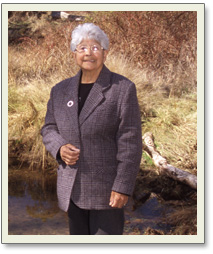
Joyce Williams went to live in an itinerants' camp at The Springs, just south of Orange, as a young girl in the 1930s. The Springs was named for its natural spring of pure, cool water. Indigenous and non-indigenous families lived there in makeshift houses. Some of the men did 'relief' work on the roads while women and children picked blackberries to sell in summer. Joyce, now a resident of Wellington, has spent many years working in Aboriginal health.
"The water at The Springs was beautiful – they couldn't have given it a better name than The Springs. I've never tasted water like it since – we loved it."
I was born in Wellington. I might have been about nine or ten when I went to Orange. There were a lot of people at The Springs – about fourteen families, not only Aboriginal families; there were white people as well. They all got on well together.
The water at The Springs was beautiful – they couldn't have given it a better name than The Springs. I've never tasted water like it since – we loved it.
The water was cold. It ran right down to the creek and onto the railway line.
We cooked on open fires. Our floors were dirt floors. Some people got bits of wood from the tip for flooring. Everybody had horses and sulkies out at The Springs, nobody had a car.
We used to go up around the Pinnacle and all around Orange and pick blackberries in summer. We used to have a little bat and knocked the blackberries off into a tin. We'd pick on the creeks too because that's where the best ones were. It took a lot of work to fill one tin.
It was cold at The Springs in winter time. There would be snow around. Everybody wore boy's shoes because they were warm.
We left there and came back to Wellington and gradually other people went away. I don't know what happened to The Springs.
Painting by Joanne Reid

This image depicts waterways in the district.
Canowindra Fish Fossils
A chance discovery by a country road-worker in 1956 led to one of the world’s great fossil discoveries at Canowindra in NSW. The road-worker turned over a rock slab, saw strange markings on the rock under-surface, pushed it aside and saved it.

The original slab was sent to Australian Museum where it has been on display since 1966. This 1956 slab bears detailed impressions or natural moulds of more than 100 Late Devonian fish, most of them complete. Four different types of fish are present on the original slab.
Between 1976 and 1990 numerous attempts were made to relocate the site. With the assistance of Cabonne Council and the Canowindra community the site was re-discovered in 1993. A major excavation took place in July 1993 resulting in the excavation of 70 tonnes of fossil slabs. The new slabs contain more than 3100 fossil fish specimens. Most of the specimens are complete and they represent at least 8 species, all new to science.
The discovery of the Canowindra fishes has had and continues to have a huge impact on science. Some of the more important discoveries are outlined below:
- The largest fish in the collection, the Mandageria fairfaxi is the only fish ever found to have had a neck. The recent discovery of this is having an impact on the study of evolution worldwide.
- The Canowindra fauna is the only known mass kill population study for the Devonian period in the world. In layman’s terms, its kind of like finding Pompeii, only the community is 360 million years old.
- In total eight species of fishes have been found; all of them are new to science.

Canowindra - fossil
The Age of Fishes Museum is one of only two fish fossil museums in the world. This alone attests to the significance of the collection and the importance of the work the community is doing to ensure the collection is accessible to all people. The Museum displays many of these beautiful fossils together with live aquarium displays and wonderful recreations of life in the Devonian period.

Fossils
The ancient fossils were found just outside of Canowindra
Provided by the Age of Fishes Museum, Canowindra
Swamps and Wetlands
Orange was named Blackman's Swamp by the early white settlers; an apt name given that much of the land around the city was comprised of swamps, now regarded as wetlands. The dank and eerie environment associated with swamps in horror movies has also contributed to their reputation. Despite wetlands being regarded as worthless in the past, their environmental value is now widely recognised. Wetlands support varied flora and fauna and act as ecological filters that naturally remove pollutants from water.

Frogs are an important component of wetland ecology and rely on the habitat for protection. A frogs 'croaking' noise is what many of us associate with the sound of a wetland.
Photo: Bill Simpfendorfer
The challenge for urban planners is to ensure that development is carried out sensitively with regard to existing wetlands so that stormwater and pollutants are not carried downstream into bigger waterways.

An Orange City Council contractor eradicating willows.
Willows are eradicated by frilling the tree and injecting it with a chemical. The sap then takes the chemical into the root system. It is important to kill the roots and to continually check for re-growth. After two years the tree is felled then burnt or chipped. Native trees are then replanted on the banks to help with stabilization of the bank and to promote habitat for native birds and animals.
Photo: Acacia Regeneration
Waterways conservationists are also concerned about the impact of willow trees on local watercourses. Although willows have long been a feature of district streams and lakes, they are now regarded as a serious environmental hazard. They exclude native flora and fauna, have a high water demand, and can damage riparian zones. Removal is carried out within the city and along Blackman’s Swamp Creek and in the Lake Canobolas Reserve in accordance with best practice methods as specified by the NSW Department of Infrastructure, Planning and Natural Resources.
Stress is also inflicted on district watercourses and their attendant wildlife by competing human activities. While many of the city’s parks and sporting ovals have been built on former swampy land, the waterways themselves are sometimes in danger of over-use. Flora and fauna, especially bird life, can be adversely affected by human activity, and local environmentalists are closely monitoring areas considered to be endangered.
Rodney Tonkin

Rodney Tonkin is a retired academic with a keen interest in fly-fishing and waterways management. He is currently president of the NSW Council of Freshwater Anglers and has been a member of Orange Trout Acclimatisation Society (OTAS) for many years. He is also a member of the Recreational Fishing Freshwater Trust Expenditure Committee, which administers licence money from recreational angling. As well, he works with the Department of Primary Industries to improve waterways (including the eradication of willows) and eliminate dangers to threatened species.
"If you look at the top end of Lake Canobolas, it's all open wetland in which the bird population is coming alive again. We get white herons and ducks and other native birds there. In addition, the stream is running well and the fish are coming back. We've had rainbow trout up to two or three pounds in Meadow Creek Stream."
My career has been as an academic but I've always been interested in waterways because of my angling interest.
Lake Canobolas became infested with redfin. Orange Trout Acclimatisation Society attempted to overcome them in the late 1970s but it wasn't successful. There were hundreds of thousands of them that destroyed the food supply and any resemblance of a fishery.
The willows, through defoliation in autumn, also create a problem. Orange City Council has been extraordinarily supportive working towards eradicating willows in our streams.
If you look at the top end of Lake Canobolas, it's all open wetland in which the bird population is coming alive again. We get white herons and ducks and other native birds there. In addition, the stream is running well and the fish are coming back. We've had rainbow trout up to two or three pounds in Meadow Creek Stream.
The NSW Department of Primary Industries has been focusing on habitat restoration to improve the freshwater fisheries. The Recreational Fishing Freshwater Trust Expenditure Committee is looking at riverside habitat and eliminating the threats to species such as Macquarie perch and silver perch.
We're getting there but it takes a lot of time and a lot of effort, and it's important that we don't stand off with these major issues, and gradually work away at them.
Jill Campbell

Jill Campbell is a naturalist with a keen interest in birds. She has been bird watching for many years, firstly in her native England, and for more than 35 years in Australia. She has a particular interest in the birdlife around Spring Creek Reservoir and makes regular bird counts to ensure they are not affected by recently-introduced rowing activities on the reservoir.
"Spring Creek Reservoir is a wonderful place for all sorts of birds. The Field Naturalists have a bird day in September and they go out and see what they can see – species and numbers etc. I've been counting birds here at that time of year for probably 30 years. It is one of my favourite spots."
I've always liked watching birds on water. In 1994 the Murray-Darling Basin wanted to survey the bird life of the basin. I tended to go once a month at least. My particular place was Spring Creek Reservoir. I had a lot of data for the survey, which lasted three years, so I continued. I've now got 11 years of records.
Having counted at Spring Creek Reservoir for so many years, I know how much bird numbers can vary. I can’t say whether rowing is having an effect on the birds, but I want to know. However, it takes time.
It's been a great reservoir for the birds over the years with a lot of different species – 12 sorts of ducks, swans, grebes, waders, plovers and so on. Also blue wrens, scrub wrens, red-capped robins, scarlet robins, yellow-faced honey eaters, red-wattle birds and red-browed finches, sitellas and birds of prey - swamp harrier, little eagle, white-bellied fish eagle, black-shouldered kites and kestrels and brown hawks, Australian ravens and little ravens, crimson rosellas, galahs, cockatoos, red-rumped parrots, and the crested dove.
I will continue to monitor the birds once a month. Spring Creek Reservoir is a wonderful place for all sorts of birds. The Field Naturalists have a bird day in September and they go out and see what they can see – species and numbers etc. So I've been counting birds at that time of year for a lot longer, probably 30 years. It is one of my favourite spots.
Brett Whitley's Willow

Willows – beautiful, decorative and dangerous There are more than 300 varieties of willow, a plant that has been used for centuries to make many useful objects including baskets, fishing rods and cricket bats. These 3 varieties are commonly found in this area.
Tortured willow, Salix babylonica var. pekinensis 'Tortuosa': this type has a cork screw 'tortured' habit, valued by florist and gardeners for its decorative form.
Pussy willow, Salix caprea: has oval leaves with a silver underside and distinctive catkins. The female plant has small silvery catkins known as pussy willow. It has a strong suckering habit, which can cause problems in small gardens.
Crack willow, Salix fragilis: a highly invasive type that naturalises readily from broken twigs that float down waterways. This type of willow is now regarded as a weed and is being progressively removed from local creeks and wetlands.
Civic Water

Orange Water Supply
Gosling Creek was Orange's first reticulated water supply and was turned on in 1890 at a total cost of £32,688. The supply was said to last for the next 20 years. As Orange continued to grow so did the demand for water.
As demand for water increased, provisions were made for an additional dam. Meadow Creek Dam now Lake Canobolas was opened in 1918 and supplied Orange for approximately 13 years until Spring Creek Reservoir was completed. Two pumps, powered by coal-fired gas engines in the Meadow Creek Pumphouse, pumped water to Orange via the 2 megalitre service tank on Cargo Road. Meadow Creek Dam did not prove very successful because of droughts, water-quality problems, and having to pump water uphill into Orange.
Spring Creek Reservoir, which was opened in 1931, included a filtration plant and a water augmentation scheme. The dam was constructed downstream from Gosling Creek Dam to create a larger catchment area. The dam wall was raised in 1947 to increase its capacity to 4500 megalitres.
Suma Park Dam was completed in 1959 with a capacity of 18,100 megalitres. The catchment area for Orange's water supply now includes the three reservoirs – Suma Park, Spring Creek and Gosling Creek.

Water is turned on at Gosling Creek, Orange's first reticulated water supply.
Photo: Orange City Library

SUMA PARK DAM
Suma Park Dam during construction, the dam was officially commissioned in 1962.
Photo: Bill Simpfendorfer
Water Works Ephemera

The opening of a new water scheme is always a cause for celebration. Menus and photographs record the great event. Toasts and speeches are a feature of the launch. At the opening of the Orange water supply works in 1896 there were 12 toasts to honour everyone from the Queen to the ladies, the engineers and the press.
Collection Orange City Library
Wooden Pipe

Part of the historic wooden water pipeline which once carried Orange’s water supply from the Spring Creek Filter, down Forrest Road and Peisley Street into the city. The pipe is made from Californian redwood, bound with wire and sealed with a tar-like substance. When wet the wood expanded keeping the wire taught. Wooden pipes were still in use in Orange in the early 70s. This piece was recovered in 1986 when new water mains were being installed.
Collection Orange City Council


Tony Lawson

Tony Lawson has been working at Orange City Council's Water Treatment Plant in Icely Road for four years as an operator and mechanical fitter. The plant supplies all of Orange with treated water pumped up from Suma Park dam.
"I reckon it's a big responsibility working here. You're looking after a lot of people’s lives. We do the water tests every day to make sure the fluoride pH and chlorine levels are ok."
The pumps are down at Suma Dam. We've got three pumps which pump 300-321 litres a second.
When the water comes up to the plant it gets treated with aluminium chlorohydrate – it forms a chemical that attracts itself to dirt. It then goes into flash mixers and an impellor, then through the clarifiers. Then the water goes back – it collects the dirt and this drops to the ground.
The scrapers collect all the dirt through the valves to the sludge pit. The dirty water gets sent to the sewage treatment works and we sell it to Cadia [mine].
The water then goes into the eight filters. Water comes into site basins which are white tiled so we can see any dirt. The water overflows into a cellar where it gets treated with soda ash to correct the pH, and fluoride.
The water is then pumped to the ozone treatment plant. The ozone water is then pumped into the 20 megalitre tank. Just before it goes, chlorine gets injected into it. From these tanks it gets gravity fed into eight storage tanks around town.
I reckon it's a big responsibility working here. You're looking after a lot of people's lives. We do the water tests every day to make sure the fluoride pH and chlorine levels are ok.
Sewerage and Water Filtration
Before the introduction of a sewerage system in Orange the 'Sanitary Man' or better known as the 'San Man', 'Night Cart' or 'Dunny Man' would travel along purpose-built lanes at the back of houses during the night. This was probably performed with a horse and cart and each can exchanged for a fresh one.
The excavation of trenches and laying of pipes for a sewerage system began in 1915 with 16 miles of cement pipe laid. The ingenuity of the government engineers saw the mains follow the natural slope of Blackman's Swamp Creek to the new treatment works located nearly 2 miles away. Manholes were laid every 4 chains to allow for the clearing of blockages.
The Orange Waste Water Treatment Plant was commissioned in 1919 and has had numerous upgrades to the present standard valued at $30,000,000.00. In 1990 a second smaller plant was constructed north of the village of Spring Hill to service the villages of Spring Hill and Lucknow.
Approximately 75% of treated effluent from the Orange Waste Water Treatment Plant is exported to the Cadia Valley Operations Re-use Scheme for use in the ore extraction process and is a valuable water source for the gold mine. The remaining 25% is discharged to the nearby Blackman's Swamp Creek.
There are two main filtration plants to service Orange's water supply, the Icely Road filtration plant and the Spring Creek Filtration Plant. Water from each dam is pumped to the plant and treated before being pumped to a service tank that is then gravity fed into the reticulation process. It is proposed upgrade work will commence on Spring Creek Dam prior to Christmas.
In 2001, Council commissioned the first Ozone/Biological Activated Carbon (BAC) water treatment plant in New South Wales. This project has solved the problem of taste and odour associated with the persistent blooms of blue-green algae in Suma Park Dam. Detailed design work is currently underway for Suma Park Dam wall raising, increasing its capacity by approximately 12%.

Orange Waste Water Treatment Plant : This is the secondary treatment area featuring anoxic zone for nitrogen reduction, extended aeration, secondary

Biological Activated Carbon Filters at the Icely Road Filtration Plant, Orange. These filters remove taste and odour and toxins associated with blue-green algae blooms.
Photo: Orange City Council
Night Dunny Can

This is a traditional Australian dunny can commonly used in outdoor toilets. Can toilets were still in use in some parts of Orange in 1975. The toilet was generally located near the back fence so the can could be easily removed and a clean empty one replaced by the nightsoil collector. This dunny is missing the inside removable can and also its lid, which was essential to keep flies out of the waste.
There is a rich folklore about the wildlife of the Australian dunny and the unexpected arrival of the nightsoil collector. In the heyday of the outdoor dunny the majority of red back spider bites occurred on male genitals exposed on the thunder box. Despite their cultural significance such objects are rare in Australian museums. This may be the first time that a dunny can has been displayed in an Australian gallery.
Loan courtesy of Orange and District Historical Society
Sewer Breather

Manholes were provided at every four chains, to enable the maintenance men to clear the pipes of blockages and provision was made to allow the escape of dangerous gases.
This ornate sewer breather from central Orange reflects the attention to design found in much of the infrastructure of early water and sewerage supply in the city.
Orange City Council Collection
Norm Barnes

Norm Barnes has worked for Orange City Council for more than 30 years and has spent a number of years at Council's McLachlan Street depot as a utilities supervisor. He helps repair breaks in pipes, puts new water services into residential lots, lays sewerage lines, clears sewerage chokes and reconstructs house connections.
"All our work, once we've done it, it's buried - you don't really see too much of it."
When I first started laying water mains we used to use asbestos cement pipes. It's now progressed to using PVC. Sometimes we use polythene pipe - it's more flexible and laying the pipes is easier because you don't have to be quite so critical of the bedding material.
The drought has caused a few problems with the ground drying out. The old fibro pipes, there's no 'give' in them and they snap.
The council is moving over to a dual water system. At the start, it will be unfiltered from the dam. Any subdivision that goes in, they'll have two installations - one for potable and one for non-potable water. The non-potable water is for garden and toilet flushing. It probably is a good idea but it is very expensive to get up and running because we've got to run a new pipeline from Suma Park. Any new subdivision west of Kearney's Drive and in the Ploughmans Valley will have it.
I do quite a bit of closed circuit TV inspections of sewer mains. We've got a set-up like a stainless steel tractor which has a camera head on. It's all remote controlled. The tractor will fit into a four-inch pipe. We take colour videos of the sewerage system through it. All our work, once we've done it, it's buried - you don't really see too much of it.
James Dalton

James Dalton has worked at Orange Waste Water Treatment Plant as a plant operator since 2001. He previously worked at the Water Filtration Plant. This plant runs 24 hours a day and James is one of eight staff, comprising five operators, an environmental scientist, a liquid trade waste officer and a supervisor.
"I think the community has got no idea about what we do here. They say, 'How can you work out there?' I can’t smell anything – it's quite fine to me. All our work clothes get washed and dried here and we shower here after work - we’re not back in the Dark Ages."
Our main objective here is to get rid of all the 'nasties' in the water. The EPA [Environment Protection Authority] has put a lot more conditions in our licence – stricter controls on what we let out of our plant, phosphorus and nitrogen levels in particular. As operators we're pretty vigilant and aware of how important our role is in the environment.
This plant is one of the best in NSW. It's a multi-million dollar plant and it incorporates a lot of different processes. It runs 24 hours a day. It's all automated. Everything is run by telemetry.
The main challenge here is the running of the plant because it's quite large and involves many treatment stages. They are quite complex in controlling and balancing all the different processes and treatments to meet the requirements.
The final effluent gets pumped out to Cadia gold mine to use in their processes. Cadia takes the lot. That's the largest re-use system in Australia. It used to go into Blackman's Swamp Creek and that's why we had to reduce levels of phosphorus, nitrogen and ammonia.
I think the community has got no idea about what we do here. They say, 'How can you work out there?' I can't smell anything – it's quite fine to me. All our work clothes get washed and dried here and we shower here after work. We're not back in the Dark Ages.

